
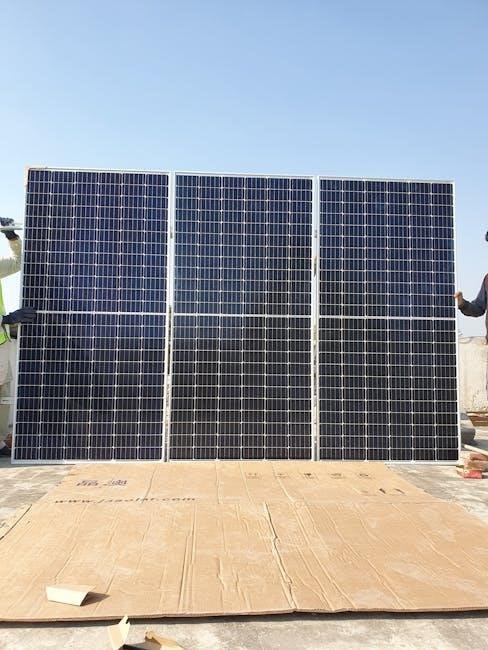
Kings MPPT controllers, detailed in manuals like the AKPSR-MPPT 01 and Rev 1.3 (EN43510), maximize solar energy harvest.
These controllers, available in 10A, 20A, 30A, and 40A models (PTR Tracer Series), efficiently regulate charging for both Lithium and SLA batteries.
What is an MPPT Solar Charge Controller?
MPPT, or Maximum Power Point Tracking, solar charge controllers are sophisticated devices that optimize the energy harvested from solar panels. Unlike traditional PWM controllers, MPPT controllers dynamically adjust the operating voltage of the solar panels to extract the maximum possible power, regardless of battery voltage or temperature.
As detailed in the Adventure Kings PLUS AKPSR-MPPT 01 user manual and other documentation like the Rev 1.3 (EN43510), these controllers utilize an intelligent algorithm to constantly track the maximum power point. This results in a significant increase – up to 20-30% – in energy utilization compared to PWM charging methods. They are suitable for regulating solar modules, ensuring efficient charging for both SLA and Lithium batteries.
Benefits of Using an MPPT Controller
Employing an MPPT solar charge controller, as outlined in manuals like the SD-2430S and PTR Tracer Series guides, delivers substantial advantages. Primarily, MPPT technology maximizes energy harvest from solar panels, boosting system efficiency by 20-30% over PWM controllers. This is achieved by constantly tracking the maximum power point, adapting to varying conditions.
Furthermore, MPPT controllers offer temperature compensation, optimizing charging performance in diverse climates. They also support various battery types, including SLA and Lithium, providing versatility. The Adventure Kings AKPSR-MPPT 01 manual emphasizes safe operation, preventing tampering and ensuring longevity. Ultimately, MPPT controllers translate to faster charging and greater energy independence.
Kings MPPT Controller Models Available
Adventure Kings offers a range of MPPT solar charge controllers, detailed in their respective manuals. The AKPSR-MPPT 01 is a popular choice, covered extensively in its downloadable user guide on ManualsLib. Additionally, the PTR Tracer Series provides options from 10A to 40A, catering to diverse power needs, as described in their documentation.
Other models, like the SD-2430S (10A, 20A, 30A) are also available, each with a dedicated user manual outlining specifications and operation. These controllers support both 12V and 24V systems. Referencing the EN43510 (Rev 1.3) manual provides insights into core MPPT algorithm functionality.

Understanding the Manual (PDF)
Kings MPPT controller manuals (like AKPSR-MPPT 01 and Rev 1.3) are crucial for safe installation, operation, and troubleshooting of your solar system.
Locating the Manual Online
Finding the Kings MPPT solar charge controller manual is straightforward. ManualsLib hosts the Adventure Kings PLUS AKPSR-MPPT 01 user manual in PDF format, readily available for download. Additionally, specific model manuals, such as the EN43510 (Rev 1.3), can often be found through direct searches on the manufacturer’s website or through online retailers where the controller was purchased.
A general web search using terms like “Kings MPPT controller manual PDF” will yield numerous results. Ensure the downloaded manual corresponds to your specific controller model (e.g., 10A, 20A, 30A) for accurate information regarding installation, settings, and troubleshooting. Always prioritize official sources for the most up-to-date documentation.
Manual Revision History (e.g., Rev 1.3 — 2022)
Tracking manual revisions is crucial for ensuring you have the most current information. The Adventure Kings PLUS AKPSR-MPPT 01 manual, and others like the EN43510 model, are subject to updates. Currently, Rev 1.3, dated 2022, is a widely available version. These revisions typically incorporate corrections, clarifications, and potentially new feature documentation based on user feedback and product improvements.
Always check the document’s title page for the revision number and date. Newer revisions supersede older ones. Manufacturers often maintain an archive of past revisions on their websites, allowing access to historical information if needed. Regularly verifying you have the latest PDF ensures accurate installation and operation.
Safety Precautions
Prioritize safety when installing and operating your Kings MPPT solar charge controller. Manuals, like the AKPSR-MPPT 01 and SD-2430S guides, strongly advise against tampering with or disassembling the regulator – doing so voids the warranty. Ensure the battery is securely mounted and properly ventilated to prevent gas buildup.
Always disconnect the solar panels and battery before making any wiring connections. Avoid short circuits and use appropriately sized wiring. Never expose the controller to water or extreme temperatures. Follow all local electrical codes and regulations. Incorrect installation can lead to fire hazard or equipment damage.
Installation Guide
Proper installation, guided by manuals like the AKPSR-MPPT 01 and SD-2430S, involves connecting solar panels, batteries, and loads with correct wiring diagrams.
Wiring Diagram Overview
The Kings MPPT controller’s wiring, detailed in manuals like the AKPSR-MPPT 01 and PTR Tracer Series guides, requires careful attention to polarity. Typically, solar panel positive and negative terminals connect to the controller’s PV input.
Battery connections – positive and negative – link to the designated battery terminals. A load can be connected to the load terminals for direct DC power.
Ensure correct wire gauge is used to minimize voltage drop and prevent overheating. The manual emphasizes avoiding short circuits and reverse polarity connections, which can damage the controller and connected devices. Always disconnect the battery before making any wiring changes.
Grounding the controller is also recommended for safety.
Connecting the Solar Panels
According to the Kings MPPT controller manuals (AKPSR-MPPT 01, PTR Tracer Series), begin by ensuring the solar panels are exposed to sunlight, though not necessarily at peak intensity. Connect the positive (+) wire from the solar panel array to the PV (+) terminal on the controller.
Similarly, connect the negative (-) wire from the panels to the PV (-) terminal.
Double-check polarity before fully tightening connections; reversed polarity can cause damage. The manual stresses using appropriate gauge wiring for the distance and panel wattage.
Securely fasten all connections to prevent loosening due to vibration or weather conditions.
Connecting the Battery
The Kings MPPT controller manual (versions like Rev 1.3 and AKPSR-MPPT 01) emphasizes safety first when connecting the battery. Ensure the controller is switched OFF before making any battery connections. Connect the positive (+) wire from the battery to the BATT (+) terminal on the controller.
Then, connect the negative (-) wire from the battery to the BATT (-) terminal.
Again, verifying correct polarity is crucial to prevent damage. The manual advises using appropriately sized fuses near the battery for overcurrent protection.
Securely tighten all connections and inspect for any loose strands.
Connecting the Load
According to the Kings MPPT controller manual (including AKPSR-MPPT 01 and Rev 1.3), the load connection utilizes the LOAD (+) and LOAD (-) terminals. Ensure the controller is powered on after battery connection, but before connecting the load. Connect the positive (+) wire of your DC load to the LOAD (+) terminal, and the negative (-) wire to the LOAD (-).
The manual stresses checking the load’s voltage and current requirements against the controller’s specifications.
Fuses are recommended near the load for safety.
Properly sized wiring is essential for efficient operation.

Controller Settings and Configuration
Kings MPPT controllers, per the manual (Rev 1.3 & AKPSR-MPPT 01), require battery type selection (SLA or Lithium) and customizable charging profiles for optimal performance;
Battery Type Selection (SLA, Lithium)
Selecting the correct battery type is crucial for optimal charging and longevity, as detailed in the Kings MPPT controller manuals (AKPSR-MPPT 01, Rev 1.3). The controller supports both Sealed Lead Acid (SLA) and Lithium battery chemistries.
Incorrect settings can lead to undercharging or overcharging, significantly reducing battery lifespan. The manual emphasizes carefully reviewing your battery specifications before making a selection within the controller’s settings menu.
For SLA batteries, options often include flooded, gel, and AGM types, each requiring slightly different charging parameters; Lithium settings should be configured based on the specific Lithium chemistry (LiFePO4, etc.).
Always consult the battery manufacturer’s documentation for recommended charging voltages and currents.
Charging Profiles and Customization
Kings MPPT controllers, as outlined in manuals like the AKPSR-MPPT 01 and Rev 1.3, offer customizable charging profiles to optimize battery performance. Users can typically adjust parameters like bulk, absorption, float voltages, and equalization settings.
These adjustments allow tailoring the charging process to specific battery types and usage patterns. The manual stresses the importance of understanding these settings before modification, as incorrect values can damage the battery.
Pre-defined profiles for common battery types simplify setup, but advanced users can create custom profiles for specialized applications. Temperature compensation is also often adjustable within these profiles.
Voltage Settings (12V/24V)
Kings MPPT controllers, detailed in manuals such as the AKPSR-MPPT 01 and Rev 1.3 (EN43510), are commonly configured for either 12V or 24V battery systems. The manual emphasizes verifying the battery bank voltage before connecting the controller.
A dip switch or menu setting typically selects the appropriate voltage. Incorrect voltage selection can lead to controller malfunction or battery damage. The controller automatically detects the system voltage in some models.
Proper voltage configuration ensures optimal charging efficiency and prevents overcharging or undercharging. Refer to the manual for specific instructions on changing voltage settings for your model.
Current Limits and Adjustments
Kings MPPT controllers, as outlined in manuals like the AKPSR-MPPT 01 and Rev 1.3 (EN43510), often feature adjustable current limits to protect the battery and controller. These limits prevent excessive current flow from the solar panels, especially in high-sunlight conditions.
The manual details how to access and modify these settings, typically through a menu interface. Adjusting the current limit is crucial when using different sized solar arrays or battery banks.
Setting appropriate limits safeguards against overheating and potential damage, ensuring long-term system reliability. Always consult the manual before making adjustments.

Display and Indicators
Kings MPPT controllers utilize LCD screens and LED indicators, detailed in the manual, to display vital system information like voltage, current, and error codes.
LCD Screen Information
The LCD screen on Kings MPPT solar charge controllers provides a comprehensive overview of the system’s performance. Key data displayed includes real-time battery voltage, indicating the state of charge and overall health. Solar panel input voltage and current are also shown, allowing users to monitor energy harvesting efficiency.
Load current and power consumption are visible, aiding in understanding energy usage patterns. Furthermore, the display showcases charging status – Bulk, Absorption, Float – providing insight into the charging process. Error codes, when present, are clearly indicated, facilitating quick troubleshooting. The manual details each parameter, ensuring users can effectively interpret the information for optimal system management and performance monitoring.
LED Indicator Meanings
LED indicators on Kings MPPT controllers offer quick status checks. A solid green “Charging” LED signifies normal operation, while a flashing green indicates the battery is fully charged and in float mode. A red “Fault” LED signals an error condition, requiring troubleshooting based on accompanying error codes displayed on the LCD screen.
The manual clarifies that a flashing red LED often indicates low battery voltage or a disconnected solar panel. A dedicated LED may also show the status of temperature compensation. Understanding these visual cues, detailed within the controller’s PDF manual, allows for immediate identification of potential issues and proactive system maintenance, ensuring optimal performance and longevity.
Error Codes and Troubleshooting
Error codes displayed on the Kings MPPT controller’s LCD screen, as detailed in the manual (Rev 1.3 & AKPSR-MPPT 01), pinpoint system faults. Common codes include “Low Voltage,” indicating insufficient battery power, and “Overvoltage,” suggesting a potential issue with the solar panel input.
Troubleshooting steps involve verifying wiring connections, checking battery voltage, and ensuring the solar panel is receiving adequate sunlight. The manual emphasizes avoiding tampering with internal components. If errors persist, consulting a qualified technician is recommended. Addressing these codes promptly, guided by the PDF, prevents damage and restores optimal charging performance.

Advanced Features
Kings MPPT controllers utilize sophisticated algorithms for maximum power point tracking, temperature compensation, and potentially data logging, as outlined in the manual.
Maximum Power Point Tracking (MPPT) Algorithm
The core of Kings MPPT controllers lies in their advanced Maximum Power Point Tracking (MPPT) algorithm. This technology continuously scans the solar panel array to identify the voltage and current combination that yields the maximum power output. Unlike PWM controllers, MPPT dynamically adjusts the operating point, ensuring optimal energy transfer regardless of varying sunlight conditions or panel temperature.
Manuals, such as the one for the AKPSR-MPPT 01, detail how this algorithm minimizes power loss and tracking time, swiftly locating the MPP. It can increase energy utilization by 20-30% compared to PWM methods, maximizing the efficiency of your solar system and providing a substantial return on investment; The controller adapts to changing conditions, consistently extracting peak performance from your solar panels.
Temperature Compensation
Kings MPPT solar charge controllers incorporate temperature compensation to optimize battery charging across a wide range of environmental conditions. As temperature fluctuates, battery voltage changes; this feature adjusts the charging parameters accordingly, preventing overcharging in hot weather and undercharging in cold weather.
The controller’s manual (like Rev 1.3 — EN43510) explains how this ensures prolonged battery life and sustained performance. By monitoring temperature, the MPPT algorithm fine-tunes the charging process, maintaining optimal battery health. This intelligent adaptation is crucial for systems operating in diverse climates, maximizing efficiency and reliability throughout the year.
Data Logging Capabilities
Kings MPPT solar charge controllers, as detailed in manuals like the AKPSR-MPPT 01, may offer data logging features, though specifics vary by model. These capabilities allow users to record historical performance data, including voltage, current, and power generation.
This logged data is invaluable for system monitoring, troubleshooting, and performance analysis. Users can identify trends, optimize system settings, and proactively address potential issues. While not all models include extensive logging, the ability to track key parameters enhances system management and provides insights into long-term energy production. Refer to your specific controller’s manual for details.

Troubleshooting Common Issues
Kings MPPT controller manuals address issues like no charging, low voltage, and overcharge protection; always consult the PDF for specific error code solutions.
Controller Not Charging
If the Kings MPPT controller isn’t charging, the manual recommends several checks. First, verify solar panel connections are secure and receiving sunlight. Confirm the battery is correctly connected with proper polarity – reverse polarity can trigger protection.
Inspect the fuse within the controller and replace if blown. Ensure the selected battery type (SLA or Lithium) in the settings matches your battery. Low input voltage from the panels, especially during cloudy conditions, can also prevent charging.
Refer to the manual’s troubleshooting section for specific error codes displayed on the LCD screen, as these pinpoint the issue. Finally, confirm the controller isn’t in a fault state due to overvoltage or temperature protection.
Low Voltage Issues
Experiencing low voltage with your Kings MPPT controller? The manual highlights several potential causes. Insufficient sunlight reaching the solar panels is a primary factor, reducing input voltage. Check for shading or dirty panel surfaces. Verify the wiring between panels and the controller isn’t undersized, causing voltage drop.
A deeply discharged battery can also trigger low voltage readings. Ensure the battery is within the controller’s acceptable voltage range. Incorrect voltage settings (12V/24V) within the controller’s configuration can lead to issues.
Consult the manual’s troubleshooting guide for specific error codes related to low voltage and follow the recommended corrective actions.
Overcharge Protection
Kings MPPT controller manuals (like AKPSR-MPPT 01 and Rev 1.3) emphasize robust overcharge protection features. These controllers prevent battery damage by halting charging when the battery reaches its full capacity. The manual details specific voltage thresholds triggering this protection.
If overcharge protection activates frequently, review your battery type selection (SLA or Lithium) and charging profile settings. Incorrect settings can cause premature shutdown. Ensure the battery’s voltage doesn’t exceed the controller’s maximum input limit.
Inspect battery health; a failing battery may exhibit erratic charging behavior. Refer to the manual’s troubleshooting section for error codes related to overvoltage and follow the suggested solutions.
Maintenance and Care
Kings MPPT controller manuals recommend regular cleaning and wiring inspections. Firmware updates, if available, enhance performance and reliability, as detailed in the PDF.
Cleaning the Controller
Regular cleaning is crucial for optimal performance of your Kings MPPT solar charge controller, as outlined in the owner’s manual. Dust and debris accumulation can impede airflow, leading to overheating and potentially reducing the controller’s lifespan. Use a soft, dry cloth to gently wipe down the exterior surfaces.
Avoid using water, solvents, or abrasive cleaners, as these can damage the controller’s components. Pay particular attention to ventilation openings, ensuring they are free from obstructions. Inspect the controller periodically, especially in harsh environments, and clean as needed. A clean controller operates more efficiently and reliably, maximizing your solar energy harvest. Refer to the manual (Rev 1.3) for specific cleaning recommendations and safety precautions.
Inspecting Wiring Connections
Routine inspection of wiring connections is vital for safe and efficient operation, detailed within the Kings MPPT controller manual (like AKPSR-MPPT 01). Regularly check all connections – solar panel, battery, and load – for tightness and corrosion. Loose connections can cause voltage drops, reduced charging efficiency, and even potential fire hazards.
Ensure wires are securely fastened to the terminals and that there are no frayed or damaged wires. If corrosion is present, carefully clean the terminals before re-tightening. The manual emphasizes avoiding tampering with internal components. Proper wiring ensures optimal performance and longevity of your solar system.
Firmware Updates (if applicable)
Check the manufacturer’s website and the Kings MPPT controller manual (such as Rev 1.3 ‒ EN43510) for available firmware updates. These updates, if provided, can enhance controller performance, add new features, or address identified bugs. The Adventure Kings PLUS AKPSR-MPPT 01 manual doesn’t explicitly detail update procedures, suggesting this feature may be limited to certain models.
If an update is available, carefully follow the instructions provided by the manufacturer. Incorrectly performing a firmware update can potentially damage the controller, so proceed with caution. Always back up any existing settings before initiating an update, if possible.

Technical Specifications
Kings MPPT controllers, detailed in manuals like the PTR Tracer Series and AKPSR-MPPT 01, offer 12V/24V systems with varying amperage – 10A to 40A.
Input Voltage Range
Kings MPPT solar charge controllers, as outlined in manuals like the AKPSR-MPPT 01 and PTR Tracer Series documentation, demonstrate a broad input voltage capability. Typically, these controllers accommodate solar panel input voltages ranging from 15V to 50V DC, ensuring compatibility with various solar array configurations.
This wide range allows for flexible system design, accommodating different numbers of panels connected in series. The specific input voltage limits can slightly vary depending on the controller model (10A, 20A, 30A, or 40A) and the battery voltage (12V/24V) selected. Always consult the specific manual for precise specifications to guarantee optimal performance and prevent damage to the controller or connected components.
Output Voltage and Current
Kings MPPT solar charge controllers, detailed in manuals like the AKPSR-MPPT 01 and PTR Tracer Series guides, offer versatile output capabilities. These controllers commonly support both 12V and 24V battery systems, automatically detecting the system voltage. Output current varies based on the model; options include 10A, 20A, 30A, and 40A controllers.
The output is designed to efficiently charge batteries, providing a regulated voltage to prevent overcharging. The manual emphasizes matching the controller’s current rating to the battery bank’s requirements for optimal charging and longevity. Proper configuration ensures safe and effective power delivery to the connected batteries.
Efficiency Ratings
Kings MPPT solar charge controllers, as outlined in manuals like the AKPSR-MPPT 01 and PTR Tracer Series documentation, boast high efficiency compared to traditional PWM controllers. MPPT technology maximizes energy harvest, achieving efficiency gains of up to 20-30% over PWM methods. This translates to more power extracted from your solar panels, especially in suboptimal conditions.
While specific efficiency percentages vary by model, these controllers consistently demonstrate excellent performance in converting solar energy into usable battery power. The manuals highlight the MPPT algorithm’s role in minimizing power loss and quickly tracking the maximum power point, ensuring optimal system performance.